


The most common causes of the Lumbar pain are superior to the disease of spine, primarily from degenerative-distorzhik (osteocondrosis, spondyloz deformia) and back muscles.In addition, various diseases of the abdomen and pelvic organs, including tumors, can cause the same symptoms as a terrorist disk.
It is no coincidence that such patients are only to neurologists, orthopedists, urologists, and from all, of course, to local or family doctors.
Etiology of Lumbar Pain and Pathogenesis
According to modern opinions, the most common reasons for back pain:
- Pathological changes in the waist, primarily degenerative-dedoshic;
- Pathological changes in the muscles, most myofacial syndrome;
- Pathological changes in the abdominal organs;
- diseases of the nervous system.
Risk Factors for Lumbar Pain:
- severe physical activity;
- anxious work posture;
- injury;
- Cooling, drafting;
- Alcohol operation;
- depression and stress;
- Vocational diseases related to high temperatures (especially in hot stores), radiation energy, sudden temperature fluctuations and vibrations.
Among the vertebral causes of Lumbar pain:
- Root ischemia (discon radicular syndrome, discogen radiculopathy), as a result of rooting with a disk bearing;
- Reflex muscle syndromes, the cause can be a degenerative change in the spine.
Due to the wrong posture, various functional disorders of the background can play a certain role due to the wrong post, when the blocks of intervertebral compounds occur and their mobility is violated.In compensation, compensation hypermobility is developing, and leading to muscle spasmes.
Signs of the sharp compression of the spinal canal
- numbness of perineal region, weakness and numbness of legs;
- Keeping urine and defecation;
- The decrease in pain with the congestion of the spinal cord is observed, watched, followed by a numbness in pelvic spines and limbs.
Low pain in childhood and adolescence, in most cases, there are abnormalities in the development of the spine.Spinal Bifida (Spina BiFida) occurs in 20% of adults.Exam, hyperpigmentation, childbirth marks, skin-skinned skin detected and hyperkeratosis were discovered.Sometimes in urine is celebrated in disbelief, trophic disorders and weakness in the feet.
Lumber pain, lumbarization can cause - S1 Vertebra's lumbar spine - and related to sanctification, adding L5 Vertebra Sacruma.These anomalies are formed due to individual characteristics of the development of Vertabra's transverse processes.
Nosological forms
Almost all patients complain about the pain below the waist.The disease shows itself primarily with inflammation of intervertebral, contractant, local, contractant - associations and libosakral compounds) and inflammation of the spinal liens.Gradually, onscing is developing in them, loses waist, elasticity and functional mobility, bamboo bar, brittle and easily injured.The pronunciation of the disease contributes to the development of a number of lung diseases, the vital power of the lungs of the lungs, clinical manifestations of the disease, the disease.
Spinal tumors
Basically, a difference between Benign and malignant tumors caused by spine and metastatic.Bive tumors of the spine (osteochondrom, hemonform) are sometimes clinically asymptomatic.With hemangioma, there may be a spinal fracture, even small external effects (pathological fracture).
Malignant tumors originate mainly from metastatic, prostate, uterus, lungs, adrenal glands and other organs.In this case, pain occurs more often than Benign tumors - generally strengthen, strengthening with a painful, smallest movement, relaxation and deprive of sleep.A progressive deterioration of the situation has increased overall depletion and changes in the blood.X-rays, calculated tomography and magnetic resonance image are of great importance for diagnosis.
Osteoporosis
The main reason for the disease is an independent disease or a reduction in the function of endocrine glands for the general aging of the body.Osteoporosis has long been in patients receiving hormone, aminoazin, anti-tuberculosis and tetracycin.Rear pain escorted radical diseases arise due to the deformation of the intermittent and spinal disorders (myelopathy), after minor injuries, the radiculomedary artery or vertebral fracture.
Myofacial syndrome
Myofascial syndrome is the main cause of back pain.This can be overstated (in the period of severe physical activity), the extreme of muscles, and inefinitisons, inoperable posture, emotional stress, and even the shortening of a leg and even straight legs.
The pressure, which caused the so-called myofascial syndrome, often shed pressure on neighboring areas, pressure pressure.In addition to myoficascial pain syndrome, the cause of pain can be an inflamed muscle diseases - myosite.
Lumbar pain often occurs due to diseases of the internal organs: stomach and duodenum, pancreatitis, cholesistitis, urolitness, etc.However, there are clear differences, so it is possible to differentiate the pain caused by the peripheral nervous system in connection with the symptoms of the main disease.
Clinical signs of Lumbar Pain
Most of the back pain occurs between 25 and 44 years old.As a rule, there are sharp pains that last 2-3 weeks and sometimes until 2 months and chronic pains - more than 2 months.
Compression radicular syndromes (discogen radicolopathy) are characterized by heavy lifting, sudden movements or hypothermia often after a sudden start.The symptoms depend on the location of the lesion.The occurrence of the syndrome is based on the compression of a hernia disk caused by degenerative processes facilitated by static and dynamic loads, hormonal diseases and injuries (including belotration).The most pathological process covers the areas of spinal roots from Dura Mater to the Intervertebruary foramen.Can participate in the root trauma in the root trauma of the injury of the diagnosis and hypertrophe ligamentum in the body, bone growths, bone growths, epidural tissue.
Upper spinal roots (L1, L2, L3) are rarely affected: more than 3% of these are not more than 3% of all Lomber radical syndromes.L4 root, which causes a characteristic clinical picture (6%) twice (6%) twice (6%), soft pain along the internal and front surface, medial surface of the leg, medial surface (numbness, burning, creeping) in this area;Somewhat weakness of quadriseps muscle.Knee reflexes are preserved and sometimes even growing.L5 root is most affected (46%).Pain, along the outer surface of the thigh, localized to the foot and iii-v fingers along the outer-outer surface of the lower leg.Often, the sensitivity of the skin of the front of the front of the foot is accompanied by a decrease in the power of the fifth finger of the fifth.The patient makes it difficult to stop in his heel.Radiculopathy, which lasted for a long time, develops the hypothrophy of the front muscles of Tibialis.S1 root is also often affected (45%).In this case, the pain in the lower back is spread along the outer surface of the thigh, along the outer surface of the lower leg and foot.The exam often reveals the hypaljesion of the posterior surface of the foot in the foot, the power of triceps muscle and foot flexes has been reduced.It is difficult for such patients to stand on the toes of the toes.The Achilles reflex has a reduction or loss.
OneBrogenic Lomber Reflex syndrome
Can be acute or chronic.Acute back pain (LBP) (Lumbago, "Lumbago") in a few minutes or hours, often due to awkward actions.Piercing, shooting (like electric shock) is localized along the lower rear, sometimes illuminates, especially when the patient finds a comfortable position, especially if the patient is comfortable and decreases.The movement in the lumbar spine is limited, the back muscles are tense, often causes a bilateral lane symptom.So the patient stretches on his back with legs.The doctor is tilted at the knee and hip joints the affected leg in the same time.This does not cause pain, because the sick nerve is relaxed by this position of the leg.Then, tilting your foot in the hip-femoral combination, it starts to make it on the knee, and thus causing tension in the sciatic nerve that gives intense pain.Acute Lumbodynia usually lasts less than 5-6 days, sometimes less.The first attack ends faster than the next.Lumbago's re-attacks inclined to become a chronic LBP.
Atypical lower back pain
There are a number of clinical symptoms of atypical in spine or myofasial syndrome, which caused degenerative changes.These signs include:
- the appearance of pain in childhood and teenager;
- Back damage from the beginning of lower back pain;
- back pain accompanied by symptoms of fever or intoxication;
- spine;
- rectum, vagina, both legs, back pain;
- Closing food, defecation, sex, and waist pain with urine;
- Nonecological pathology visible in the background of low back pain (amenorrhea, Demenorrhea, Vaginal discharge);
- In a horizontal position, the pain in the lower back decreased in a growing and vertical position (Razdolsky's symptom, which is characteristic of a tumor in the waist);
- Suddenly increasing pain in two weeks;
- the appearance of limbs and pathological reflexes.
Exam methods
- Determination of external examination and palpation of the Lombber region, scoliosis, muscle tensions, pain and trigger points;
- Determining the range of movement in the lomber spine, the areas of muscle waste;
- examination of a neurological situation;Identification of tension symptoms (Lassegue, Wasserman, Neri).[Wasserman's symptom study: In a patient in a patient, bend in the knee joint causes pain in the thigh.Learning of Neri's symptom: The sharp bending of a patient with flat feet causes sharp pain in sharp pain and sciatic nerve.];
- Sensitivity, reflex area, muscle tone, vegetative disorders (swelling, color in color, temperature and humidity);
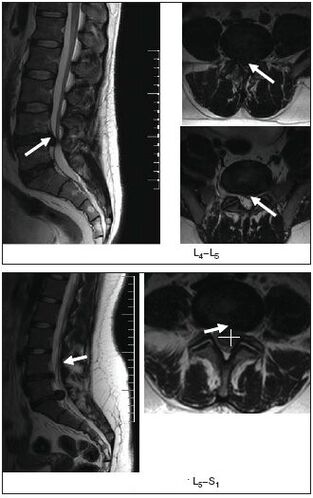
- Radiography, computer or spine magnetic resonance image.
MRI is especially informed
- Ultrasonic examination of pelvic bodies;
- gynecological examination;
- If necessary, additional studies are conducted: cerebrospinal fluid, blood and urine, Sigmoidoscopy, Colonoscopy, Gastroscopy, etc.
Treatment
The escalation of acute low back pain or vertebral or myofacial syndromes
Unsteady treatment.Delicate motor mode.When there are severe pain in the first days, the bed rest, then walk over the puppies to empty the waist.The bed should be difficult and the wooden plate should be placed under the mattress.It is recommended to warm, a woolen shawl, electric thermal pillow and heated sand or salt bags.The ointments have a useful effect: finalgon, tigers, capsin, diclofenac, etc., also mustard water and pepper plaster.The eritemal doses are recommended to irrigate the painful area with ultraviolet radiation, leeches (taking into account possible contraindications) and ethyl chloride.
There is an analgesic effect of electrical procedures: transkutan electroanaljia, sinusoidal modulated currents, diadynamic currents, novokaine, etc.Novocaine blockades, pressure massage of trigger points.
Analgesic medications, nsaids;Tranquilizers and / or antidepressants;Drugs (muscle streaks) reduced muscle tension.When the arterial hypotension, the tizanide should be shown with great caution for hypotensive effects.If the swelling of spinal roots is suspected, diuretics are determined.
Basic analgesic medications are NSAIDs that are often uncontrolled by patients when pain is intensified or read.It should be noted that the long-term use of NSAIDs and analgesics increases the risk of aggravation of this type of therapy.Currently, NSAIDs have a great choice.Patients suffering in the spine, due to the reduction of existence, effectiveness and side effects (gastrointestinal bleeding, dyspepsia), preferred "voter" drugs are 100-150 mg, Diatrofenak in the daytime.Among the verbal, intramuscular, local, local, local, local, ibuprofen and ketoprofen verbal and "selective" - in the occasional 7.5-15 mg / day melik.
Side effects may occur when treated with NSAIDs: nausea, vomiting, loss of appetite, pain in the epigastric region.Possible Ulcerogenic Impact.In some cases, ulceration and bleeding in the gastrointestinal tract can occur.In addition, headaches, dizziness, drowsiness and allergic reactions (leather rashing etc.) are recorded.The treatment is contraindicated for the gastrointestinal tract, pregnancy and ulcerative processes.It is recommended to avoid dental symptoms and drink milk or then get the NSAID during meals to prevent and reduce.In addition, for the treatment of the patient's election diseases, the long-term treatment of the treatment of many chronic diseases, as the treatment of treatment, and as a result, NSAIDs are accepted with NSAIIs.
Therefore, modern methods of conservative treatment include chondropelic, chondrostimulation effects and the mandatory use of drugs that have a better therapeutic effect than NSAIDS.Drug Teraflex-Advance fully meets these requirements, which is an alternative to NSAID for moderate pain.A capsule of medicine contains 250 mg of glucosamine sulfate 250 mg of glucosamine sulfat and 100 mg of Ibuprofen.Chondroit's sulfate and glucosamine are in connective tissue biofynthesis that help prevent creeping processes and stimulate tissue recovery.IBuProfen has an analgesic, antipyretic effects.The mechanism of the action occurs due to the selected blocking of the main enzyme in the metabolism of acids, which causes cycloxidaza, cycloxidaza (very types of products 1 and 2), prostaglandinsin synthesis.The presence of NSAIIs in Theraflex-Advance helps to increase the range of movement in combinations and reduce the stiffness of the joints and spine.It should be noted that according to R.J.MAKILIDIDS ET AL.In addition, the analgesic effect of glucosamine / ibuprofen combination is provided with the dose of ibuprofen 2.4 times.
After the relief from pain, the drugs containing active ingredients are rational to take the drug from the drug from the groom and glucosamine.Teraflex is taken 3 times a day 1 capsule.1 capsule for the first three weeks and 2 times a day.in the next three weeks.
The vast majority of patients receiving Teraflex experience a reduction in positive dynamics and neurological symptoms in the form of painkind.Medicinal patients were well-tolerated and allergic manifestations were not recorded.Teraflex use for degenerative diseases of the spine is rational in young patients, especially as NSAIDs and monotherapy.With the NSAIDS, the analgesic effect occurs 2 times faster and the need for NSAID's therapeutic doses gradually decreases.
In the clinical practice, those related to vitamins B vitamins that affect the lesions of the peripheral nervous system, including spinal osteocondrosis, neurotropic, are widely used.Traditionally, each of the vitamins B1, B1, B6 and B1, B1 and B1, B1 and B12 are used in the method of managing vitamins B1 and B1, B1, B1 and B1, B1, B1, B1 and B12.Unlimited as an alternative daily.The course of treatment is 2-4 weeks.Disadvantages of this method include the use of small doses that reduce the effectiveness of treatment and the need for injections.
For discogen radiculopathy, traction therapy is used: traction in a neurological hospital (submarine).For myofascial syndrome, after local treatment (irrigation, irrigation with novocainl blockade, ethyl chloride), a hot compresses in the muscles for several minutes.
Chronic back pain or myogenic origin
When disk hernia is recommended:
- wear a harsh corset like "heavy athletic belt";
- Restriction of physical activity, avoid sudden movements and bending;
- Physical therapy to create a muscle corset and restore muscle mobility;
- massage;
- Novocaine blockades;
- reflexology;
- Physiotherapy: ultrasound, laser therapy, heat therapy;
- Intramuscular vitamin therapy (B1, B6, B12), multivitamins with mineral supplements;
- The paroxysmal is assigned to Carbamazepine for pain.
Non-drug treatment
Despite the availability of effective means of conservative treatment, some patients require surgical treatment.
Tips for surgical treatment are relative and definitely divided.The absolute sign of surgical treatment, the development of caudal syndrome, a sequestized intervertebral disk, despite treatment, is the fact that it is a severe radical pain syndrome that does not decrease in treatment.The development of the radiculomyohakemia also requires urgent surgery, but in such cases in such cases in such cases, due to the occurrence of irreversible changes in the root, because in most cases, during treatment and rehabilitation measures in the course of about 6 months.The same regression periods are observed with delayed operations.
Relative indicators include the failure of conservative treatment and recurring sieces.The conservative therapy period should not exceed 3 months.and lasts at least 6 weeks.Surgical approach is right in the first 3 months in the event of acute radical syndrome and conservative treatment failure.After the start of pain to prevent chronic pathological changes in the root.The numbered indicator is a relative hint of adjustment when the pain component is replaced by an increase in neurological failure.
Among the physiotherapy procedures, electrophorezes with proteolitic enzyme caripazim are currently widely used.
Therapeutic physical training and massage are an integral parts of the comprehensive treatment of patients with spinal lesions.Therapeutic gymnastics aims to strengthen the body, increase efficiency, increase the coordination of actions and increase fitness.In this case, special training is directed to the restoration of certain motor functions.